History
At our school, we believe that history helps children understand the world they live in and their place within it. Through our history curriculum, we aim to inspire curiosity about the past and develop pupils' understanding of how people, events and societies have shaped the world today. We want our children to think like historians: asking questions, analysing evidence, considering different viewpoints and making informed judgements about the past.
In the Early Years Foundation Stage, children begin to develop an understanding of the past through the United Curriculum. They explore changes within their own lives, learn about significant people and events, and begin to recognise similarities and differences between the past and present. These early experiences provide the foundations for historical learning throughout Key Stages 1 and 2.
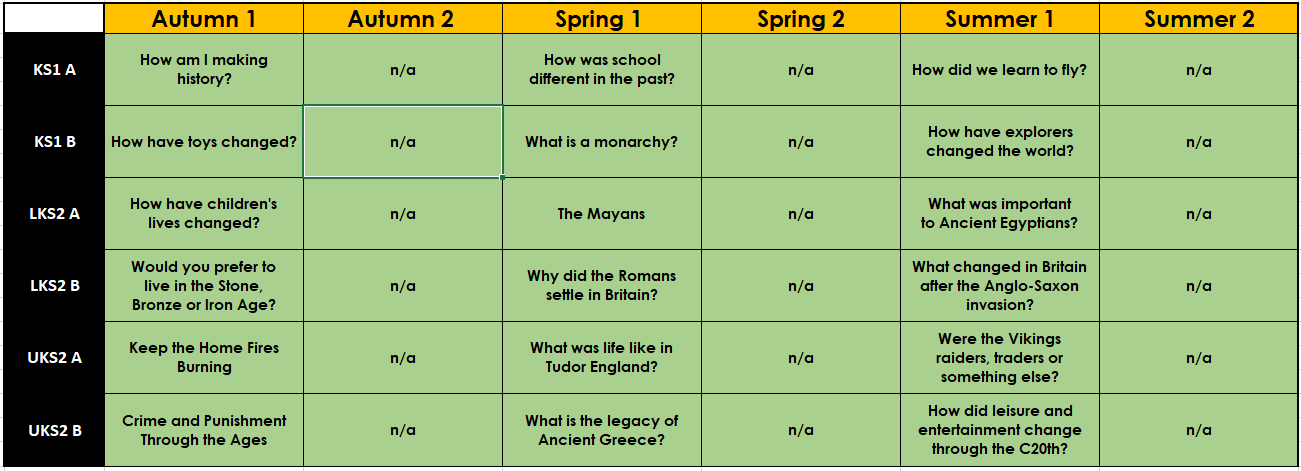
From Years 1 to 6, we follow the Kapow History scheme of work, which provides a carefully sequenced and knowledge-rich curriculum. Pupils develop both substantive knowledge (the facts, concepts and vocabulary of history) and disciplinary knowledge (the skills and methods used by historians). Through this approach, children gain an increasingly secure understanding of chronology, significant events, civilisations and historical themes while learning how historians investigate and interpret the past.
Our curriculum is built around key disciplinary concepts that are revisited and developed throughout each year group:
-
Historical significance
-
Continuity and change
-
Cause and consequence
-
Historical enquiry
-
Evidence and interpretation
-
Similarity and difference
As pupils progress through the school, they build upon prior learning and make connections between historical periods, societies and events. They develop a secure chronological understanding of British history alongside studies of ancient civilisations and significant world history. Learning is carefully sequenced to enable children to deepen their knowledge over time and become increasingly confident and knowledgeable historians.
We place great importance on developing historical vocabulary and ensuring that key knowledge is retained. Through regular retrieval practice, discussion and enquiry-based learning, children are encouraged to remember more, know more and apply their understanding with increasing confidence.
Our history curriculum enables pupils to explore themes such as settlement, civilisation, conflict, migration, power, democracy and social change. Through studying a diverse range of people, cultures and historical experiences, children develop an appreciation of the complexity of the past and a deeper understanding of equality, diversity and respect in modern society.
By the time they leave our school, pupils will have developed a secure understanding of Britain's past and its relationship to the wider world. They will be equipped with the knowledge, skills and critical thinking needed to evaluate evidence, challenge assumptions and understand how history continues to influence the present and shape the future.