Geography
At our school, we believe that geography helps children make sense of the world around them and understand their place within it. Through our geography curriculum, we aim to inspire curiosity about the Earth's people, places and environments, while developing a sense of responsibility for the world we share. We want our children to think like geographers: asking questions, exploring relationships between people and places, and understanding how human and physical processes shape the world.
In the Early Years Foundation Stage, children begin their geographical learning through the United Curriculum. They explore their immediate environment, develop an understanding of their local community and begin to make comparisons between places. Through observation, discussion and exploration, children develop the vocabulary and knowledge needed to understand the world around them and form the foundations for future geographical enquiry.
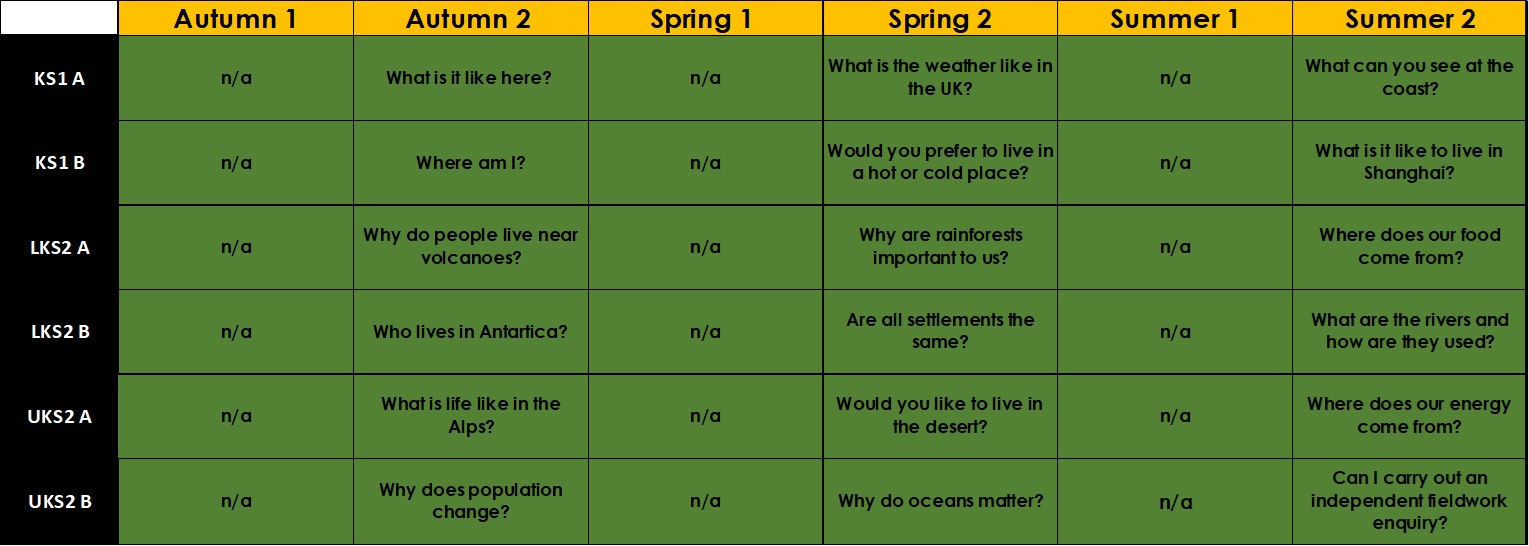
From Years 1 to 6, we follow the Kapow Geography scheme of work, which provides a carefully sequenced and progressive curriculum. Pupils develop both substantive knowledge (facts, concepts and vocabulary) and disciplinary knowledge (the skills and methods used by geographers). Through this approach, children build an increasingly secure understanding of locations, places, environments and geographical processes while developing the skills needed to investigate and interpret the world around them.
Our geography curriculum is built around key disciplinary concepts that are revisited and developed throughout each year group:
-
Locational knowledge
-
Place knowledge
-
Human and physical geography
-
Environmental awareness and sustainability
-
Geographical skills and fieldwork
-
Mapping and spatial understanding
As pupils progress through the school, they deepen their understanding of their local area before extending their knowledge to the United Kingdom and the wider world. Learning is carefully sequenced to help children make meaningful connections between geographical concepts and apply their knowledge in increasingly complex contexts.
We place great importance on developing geographical vocabulary and ensuring that key knowledge is retained over time. Through regular retrieval opportunities, practical enquiry and fieldwork experiences, pupils are encouraged to remember more, know more and apply their understanding with confidence.
Fieldwork is a vital part of our geography curriculum. Children learn to observe, investigate, collect data and draw conclusions about the environments they study. They develop proficiency in using maps, atlases, globes, digital mapping technologies and geographical data to support their understanding of places and spatial relationships.
Our curriculum enables pupils to explore important themes such as settlement, migration, climate, sustainability, natural resources and globalisation. Through these studies, children develop an appreciation of the interconnectedness of our world and gain an understanding of the environmental and social challenges facing communities both locally and globally.
By the time they leave our school, pupils will have developed a secure understanding of their local area, the United Kingdom and the wider world. They will be equipped with the geographical knowledge, enquiry skills and critical thinking needed to understand complex global issues and become informed, responsible citizens of the future.