Spanish
At our school, we believe that learning a modern foreign language opens doors to new cultures, broadens horizons and develops pupils' confidence as communicators. Through our Spanish curriculum, we aim to foster a curiosity and appreciation for different languages and cultures while equipping children with the knowledge and skills needed to communicate effectively in another language.
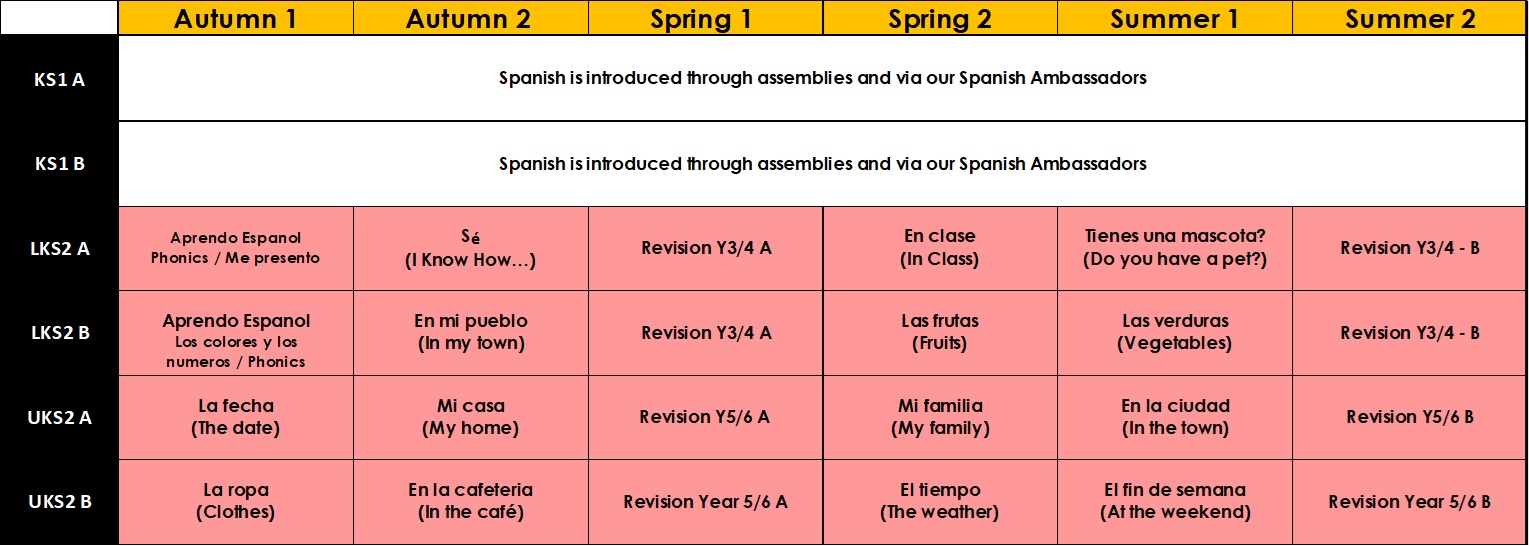
Although formal Spanish lessons begin in Key Stage 2, we seek to promote language learning across the whole school. Through assemblies, cultural celebrations and the work of our Spanish Ambassadors, younger pupils are introduced to basic Spanish vocabulary and simple phrases, helping to build enthusiasm and familiarity with the language before formal study begins.
From Years 3 to 6, we follow the Language Angels scheme of work, which provides a progressive and carefully sequenced curriculum. Pupils develop their skills in speaking, listening, reading and writing Spanish while building their knowledge of vocabulary, grammar and sentence structures. Learning is designed to revisit and build upon prior knowledge, enabling children to develop increasing fluency and confidence as they progress through the school.
We recognise the importance of securing key vocabulary and language structures. Throughout the year, dedicated retrieval units provide opportunities for pupils to revisit and consolidate essential language, including greetings, numbers, colours, days of the week, months of the year and other high-frequency vocabulary. This planned revision supports long-term retention and helps pupils make meaningful connections between new and prior learning.
Technology plays an important role in supporting language acquisition. Pupils are encouraged to engage with independent learning through Duolingo, providing additional opportunities to practise vocabulary, pronunciation and language structures beyond the classroom.
Our Spanish curriculum also develops pupils' understanding of the cultures, traditions and daily lives of people in Spanish-speaking countries. Through this cultural learning, children develop respect, empathy and an appreciation of the diversity of the wider world.
By the time they leave our school, pupils will have developed the confidence to communicate using familiar Spanish vocabulary and phrases, understand and respond to spoken and written language, and apply their knowledge creatively in a range of contexts. They will leave with a positive attitude towards language learning and an appreciation of the value of communicating with people from different cultures and backgrounds.