Design Technology
At Moresby Primary School, we believe that Design Technology gives children the opportunity to think creatively, solve problems and turn their ideas into practical solutions. We want children to develop the confidence to design, make and evaluate products, while developing the practical skills and technical knowledge they need to understand the designed and manufactured world around them.
We follow the Kapow Design Technology scheme of work, which provides a carefully sequenced programme of learning across the school. Children encounter a broad range of materials, techniques and technologies, including mechanisms, structures, textiles, electrical systems, robotics and food technology.
Across the different areas of Design Technology, children learn to identify problems and design purposeful solutions. They develop their ability to research, generate and communicate ideas, select appropriate materials and tools, make and modify products, and evaluate their finished work. They learn that designing and making is an iterative process, where testing, improving and sometimes starting again are important parts of achieving a successful outcome.
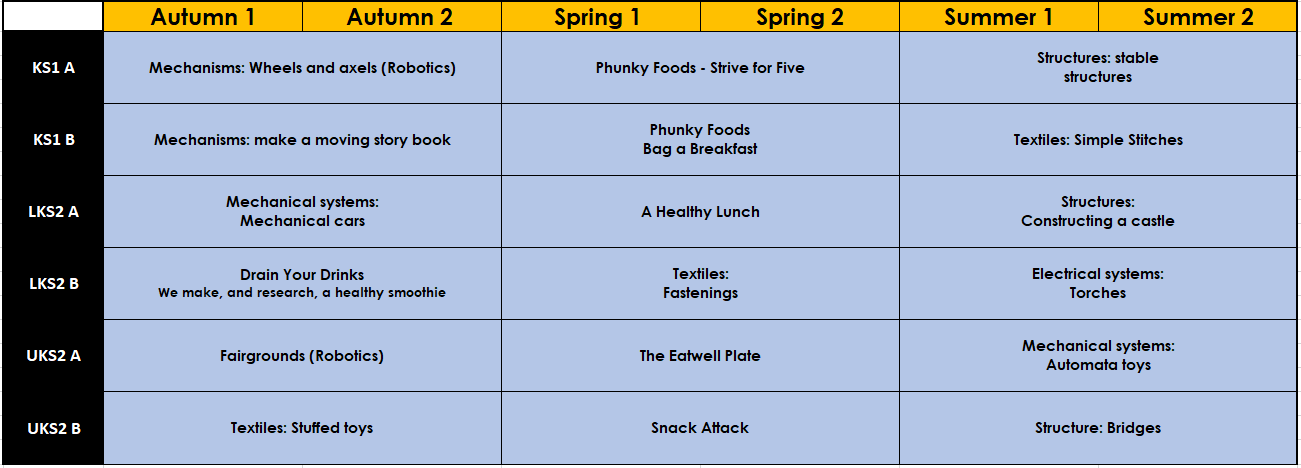
Our curriculum provides children with opportunities to develop practical skills progressively. In Key Stage 1, children explore mechanisms through projects such as moving story books and wheels and axles, develop their understanding of structures and textiles, and learn about preparing healthy food. As they progress through Key Stage 2, they encounter increasingly complex projects including mechanical cars, electrical torches, automata toys, bridges and robotics, alongside more advanced textile and food projects.
Food technology is an important part of our Design Technology curriculum. Children learn about healthy eating, nutrition, food preparation and the safe use of equipment, designing and making food products for particular purposes. Projects such as A Healthy Lunch, Drain Your Drinks, The Eatwell Plate and Snack Attack allow children to apply their knowledge of nutrition while developing practical cooking skills.
We also encourage children to see the connections between Design Technology and other areas of the curriculum. Science, mathematics, computing and art all contribute to the way children design, construct, test and refine their ideas. Through projects involving robotics and electrical systems, for example, children begin to understand how technology can be used to solve problems and make things work.
Above all, we want our children to become creative, resourceful and resilient problem-solvers. Whether they are constructing a castle, programming a robotic vehicle, sewing a stuffed toy, designing a bridge or preparing food, we want them to take pride in what they create and understand that good design comes from curiosity, careful thinking, practical skill and a willingness to improve.